
The Rhine Getaway:
Amsterdam To Basel
April 20 - april 27, 2028
book this trip
A few months ago I stepped aboard my first Viking river cruise and understood immediately why people fall in love with this way of traveling. It wasn't only the scenery. It was the easy pace, the intimate ship, and waking up in the heart of a new European destination each morning — unpacking once, settling in, and actually enjoying the journey.
I knew right away I wanted to host a group of my own. This route brings together so much of what I love about Europe: Amsterdam in tulip season, storybook castles along the Middle Rhine, old towns and regional wine, and the simple pleasure of watching the landscape unfold from the river.
Come with a spouse, a friend, family, or on your own. You'll have a welcoming group and a familiar face onboard, with the freedom to enjoy the cruise however feels right to you.
— Jen Johnson, Luxury Travel Advisor and Viking Cruise Line Specialist
Hosted by Jen Johnson

Tulips. Castles. Vineyards. The heart of Europe.
Eight days and four countries aboard a Viking Longship, sailing the Rhine from Dutch windmills to the Swiss border.
Day 1 - Thursday, April 20
EMBARKATION IN AMSTERDAM
Kinderdijk is a small village in the Alblasserwaard, where the waters of the Rhine Delta have shaped the land for centuries. Nineteen 18th-century windmills stand here, remarkably preserved — they pumped the surrounding polders dry, turning seabed into farmland behind a system of dikes. Walking among them is the clearest picture you'll get of how the Dutch built their country. This is the landscape behind the 1865 novel Hans Brinker, and the boy who plugged the leaking dike with his finger.
Day 2 - Friday, April 21
KINDERDIJK, THE NETHERLANDS
Day 3 - Saturday, April 22
COLOGNE, GERMANY
Cologne wears its Roman past in its street plan and in ruins scattered through the center, but the building everyone comes for is the 13th-century cathedral. A UNESCO World Heritage Site and one of the great works of Gothic architecture, it survived Allied bombing in the Second World War; its twin spires are visible for miles, and inside, the stained glass floods the nave with color. Climb to the viewing platform if you have the legs for it. Afterward, the shops and restaurants along Hohe Strasse are a short walk from the cathedral steps.


Day 4 - Sunday, April 23
Koblenz was founded more than 2,000 years ago where the Moselle meets the Rhine, and the old center still looks the part — cobbled streets, wood-beamed houses, a medieval market square. The Basilica of St. Castor, the city's oldest building, dates to 836; the Teutonic Knights established their first base here in 1216. At the German Corner, an enormous equestrian statue of Prince William I looks out over the confluence.
The stretch we sail afterward is the reason many people book this river. The Middle Rhine is a UNESCO World Heritage Site, and its banks rise in vineyard terraces so steep the grapes are still picked by hand. Castles stand above nearly every bend. At the sharpest of them, the Lorelei Rock — where, the story goes, a river maiden's song drew sailors onto the rocks below.
We arrive in Rüdesheim, the winemaking center of the Rheingau. The Drosselgasse is a narrow cobbled lane of taverns pouring local vintages, with music spilling into the alleys off it. Brömserburg Castle, built in the 9th century, is the oldest on the Rhine, and Siegfried's Mechanical Music Cabinet houses a collection of self-playing instruments worth the detour.

KOBLENZ & RÜDESHEIM, GERMANY — SCENIC SAILING, THE MIDDLE RHINE

Day 5 - Monday, April 24
SPEYER, GERMANY
Speyer sits quietly on the west bank of the Rhine, and its Romanesque imperial cathedral is the burial place of eight emperors, including some of the most consequential of the Holy Roman Empire. The town was a major Celtic center long before that, and changed hands repeatedly between Romans and Huns. The word Protestant was coined here: at the Diet of Speyer in 1529, fourteen free German cities and six Lutheran princes protested the Edict of Worms, which had banned Martin Luther's writings and declared him an enemy of the state.
Day 6 - Tuesday, April 25
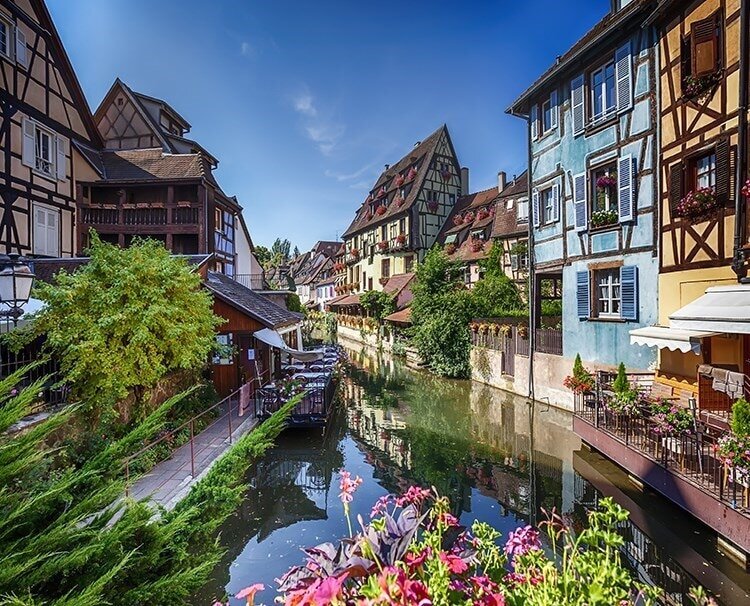
The largest port on the Upper Rhine and the cultural center of Alsace, Strasbourg sits close enough to the German border that the two influences have long since folded into one another — in the architecture, the language, and especially the food. The old town is ringed entirely by the little Ill River, which makes it an island, compact enough to cross on foot. Cobbled streets, timber-framed houses, canals at unexpected turns. Give yourself an hour for Alsatian café culture: coffee and cake among the half-timbered houses is the whole point of being here.
STRASBOURG, FRANCE
The Rhine Awaits!
book this trip

Day 8 - Thursday, April 27
DISEMBARKATION IN BASEL
Bid farewell to your fellow guests and journey home — or stay on and see Basel properly. The city sits where Switzerland, Germany, and France meet, at the farthest navigable point of the Rhine, and the blend shows in everything. An old town huddles along the riverbank; around Market Square, guild houses run through Gothic, Renaissance, and Baroque, with the red-sandstone Rathaus at the center. More than forty museums give the place a contemporary edge. Cheese fondue or a croissant, depending which border you're facing.
Here's what our itinerary has in store:
Embark your ship and settle into your stateroom. Amsterdam is a city built on water — a ring of 17th-century canals lined with narrow gabled houses leaning companionably into one another, best seen slowly and on foot. Late April places you here in the middle of tulip season, when the flower markets and the fields outside the city are at their peak. Settle in, meet Jen and your fellow travelers, and spend your first evening onboard.
Day 7 - Wednesday, April 26
BREISACH, GERMANY & THE BLACK FOREST
Breisach sits on a basalt outcrop rising out of the Rhine plain, in one of the warmest corners of Germany and directly across the river from Alsace. It's the gateway to the Black Forest, and it holds its own on wine: Europe's largest cellars are here, with capacity for more than 160 million liters. The town's landmark is St. Stephen's Cathedral, built between the 12th and 13th centuries in a mix of Romanesque and Gothic, its two towers visible from across the city and from the water.*Please Note: Black Forest Hike is weather dependent and may only operate at certain times of year. Please refer to your final documents for details.